PhD and Postdoc Research Opportunities 2026: STEM, Sustainability, and Conservation
Top 2026 PhD and Postdoc positions in Green Ammonia, Biomaterials, Coastal Plastic Simulation, and more. Find fully funded academic roles at Radboud, Oxford, and Dalhousie.
The global research landscape in 2026 is defined by a shift toward “Green” technology, advanced biomaterials, and environmental restoration. As the world moves toward decarbonization and personalized medicine, universities are seeking the next generation of researchers to solve complex, multi-scale challenges.
The most significant PhD and Postdoctoral opportunities currently available at prestigious institutions worldwide, ranging from the Netherlands and the UK to Canada and Malaysia.
1. PhD Position: In Situ NMR for Green Ammonia Synthesis (Radboud University)
Decarbonizing industrial chemistry is one of the greatest challenges of the 21st century. Ammonia production via the traditional Haber–Bosch process currently accounts for roughly 3% of global $CO_2$ emissions.
The Research Goal
The MReChem group at Radboud University’s Magnetic Resonance Research Center (MRRC) is seeking a PhD candidate to investigate lithium-mediated electrochemical nitrogen reduction. This process offers a low-carbon alternative to traditional methods but requires a deeper mechanistic understanding of the solid–electrolyte interphase (SEI) and reactive intermediates.
Scientific and Societal Context
Ammonia synthesis underpins global food production through fertilisers and is indispensable to modern agriculture. However, the conventional Haber–Bosch process operates under high temperature and pressure and contributes approximately three percent of global carbon dioxide emissions. As the world seeks sustainable alternatives, lithium-mediated electrochemical nitrogen reduction has emerged as a promising low-carbon route for ammonia synthesis.
Despite its potential, this electrochemical pathway remains energy-inefficient due to limited mechanistic understanding at the electrode–electrolyte interface. Bridging this knowledge gap is essential for transforming laboratory concepts into industrially viable green ammonia technologies.
Research Focus and Methodology
This PhD project forms part of a prestigious NWO Vidi-funded programme and focuses on the development of interface-selective and operando nuclear magnetic resonance methods. The doctoral researcher will work on:
Applying advanced in situ NMR techniques to directly probe lithium metal during ammonia synthesis
Investigating the formation and chemical nature of the solid–electrolyte interphase
Studying the role of proton donors in nitrogen activation and reaction kinetics
Correlating lithium morphology with electrochemical performance
Combining multinuclear NMR with solid-state magic-angle spinning NMR
Integrating electrochemical measurements with complementary characterisation techniques
Through these approaches, the project aims to provide unprecedented molecular-level insight into reaction mechanisms under realistic operating conditions.
Research Environment and Career Prospects
The Magnetic Resonance Research Center offers access to world-class infrastructure, including ultra-high-field solid-state and solution NMR systems, benchtop instruments, and custom-built probes. The PhD candidate will work within a highly international environment, collaborate with leading academic and industrial partners, and contribute to high-impact scientific publications.
Graduates from this programme are exceptionally well positioned for careers in academic research, energy materials development, advanced instrumentation, and industrial R&D focused on sustainable chemical processes.
What You Will Do:
-
Apply the advanced eReactor NMR probe to study reactions under operando conditions.
-
Probe lithium metal morphology and nitrogen activation kinetics.
-
Collaborate with international cryo-EM and electrochemistry experts.
Compensation & Perks:
-
Fully funded 4-year position.
-
Salary: Year 1 (€3548) scaling to Year 4 (€4501) per month.
-
Access to state-of-the-art ultra-high-field NMR instrumentation.
Apply Now: Radboud University PhD Details
2. PhD in Stimuli-Responsive Biomaterials (University College Dublin)
Merging materials science with organoid biology, the UCD Dynamic Biomaterials Group is offering a 4-year PhD position starting in Spring 2026. This project is ideal for researchers interested in how mechanical signals shape the development of human tissues.
Research Background
Organoids are three-dimensional cellular constructs that replicate key structural and functional aspects of human organs. They have transformed research in developmental biology, disease modelling, and drug discovery. However, the physical and mechanical cues that govern organoid development, morphology, and function remain poorly understood.
The mechanical properties of the surrounding biomaterial matrix play a crucial role in cell fate decisions, tissue organisation, and long-term functionality. Understanding these interactions requires an interdisciplinary approach that combines experimental materials design with biological analysis and computational modelling.
Core Research Components
This PhD project integrates several complementary research strands:
Design and synthesis of stimuli-responsive biomaterials tailored for organoid culture
Physical characterisation of matrix stiffness, viscoelasticity, and responsiveness
Biological characterisation of organoid growth, differentiation, and morphology
Application of discrete element modelling to simulate mechanical cell–matrix interactions
Integration of experimental data with computational predictions
The project is designed to provide the PhD researcher with a broad yet deep skill set spanning materials engineering, cell biology, and computational science.
International Collaboration and Training
The research will be conducted in collaboration with a leading European laboratory specialising in multicellular system dynamics. This international partnership ensures exposure to diverse methodologies, collaborative research culture, and advanced training opportunities.
Doctoral graduates from this programme are well suited for careers in academic research, biomedical engineering, regenerative medicine, and biotechnology innovation.
The Focus:
-
Design stimuli-responsive biomaterials for organoid culture.
-
Utilize Discrete Element Modelling (DEM) to simulate cellular mechanical signals.
-
Collaborative research with the Multicellular System Dynamics Lab at KU Leuven.
Deadline: February 20th, 2026.
How to Apply:
✅ If this sounds like something for you please submit your application in the Google form (https://docs.google.com/forms/d/e/1FAIpQLSdqJmgSYf8D5GRuLfUSuOiL0Q5o3i8xC99TgWjWdKwx-CUjaA/viewform?pli=1) until February 20th 2026.
📩 Please feel free to reach out to me for further information on the project, but note email applications will not be accepted.
3. Marine Turtle Conservation Project (MTCP) Field Placements
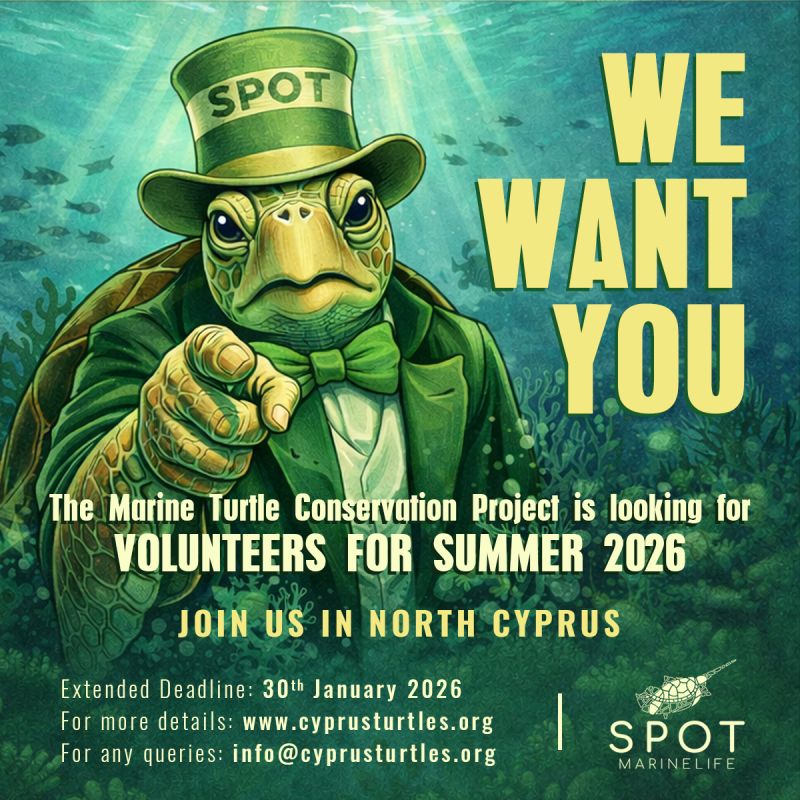
For those passionate about hands-on environmental work, the Society for the Protection of Turtles (SPOT) in North Cyprus has extended its application deadline for the 2026 nesting season.
Conservation History and Mission
The Society for the Protection of Turtles was founded in the late 1980s with the aim of conserving marine turtles in the Eastern Mediterranean. Early field surveys revealed the global importance of nesting beaches in North Cyprus, prompting long-term collaboration with academic institutions and environmental authorities.
Over the decades, the project has evolved into a comprehensive marine conservation programme combining scientific research, habitat protection, and community engagement.
Fieldwork and Research Activities
Participants in the Marine Turtle Conservation Project contribute directly to conservation science through:
Monitoring nesting activity of green and loggerhead turtles
Collecting data on hatchling success and survival
Supporting long-term population assessments
Assisting with ecological surveys and environmental monitoring
Participating in research on marine pollution and fisheries interactions
Broader Marine Research Scope
In addition to sea turtles, the organisation conducts research on monk seals, dolphins, whales, sharks, rays, invasive species, and marine pollution. These placements provide invaluable experience for students and early-career researchers considering futures in marine biology, environmental science, or conservation policy.
The Opportunity:
-
Fieldwork: Hands-on protection of green and loggerhead sea turtles.
-
Research Areas: Sea turtles, monk seals, fisheries, and bioinvasives.
-
Duration: 4–8 weeks (volunteer fee: £900).
New Deadline: January 30th, 2026.
Apply MTCP Application Form: https://docs.google.com/forms/d/e/1FAIpQLSfzb9EDgCGWeAJFncfjWEp7zQj2EDIX2mq7mA627RFP63i2HA/viewform
Official Website: https://cyprusturtles.org/
4. Postdoc in Coastal Plastic Pollution Simulation (Utrecht University)
Utrecht University’s IMAU is seeking a postdoctoral researcher for an NWO Vici-funded project: “Tracing Marine Macroplastics.” This role combines numerical modeling with experimental field observations.
Research Context
Large plastic debris, known as macroplastics, pose severe threats to marine organisms and coastal ecosystems. Their distribution is highly variable in space and time, complicating mitigation and clean-up efforts. Understanding the physical processes governing macroplastic transport is essential for effective intervention strategies.
This postdoctoral project is part of a major research initiative funded by the Dutch Research Council and aims to develop predictive tools for macroplastic dispersion in Northwest European coastal waters.
Scientific and Technical Objectives
The postdoctoral researcher will work on:
Simulating buoyant macroplastic transport using Lagrangian particle tracking methods
Developing high-resolution coastal flow models
Writing and maintaining Python-based simulation code
Comparing model results with experimental data from field campaigns
Collaborating with researchers working on large-scale ocean circulation models
Contributing to the development of open-source modelling frameworks
Professional Development and Impact
Beyond technical expertise, the project emphasises interdisciplinary collaboration, open science, and science communication. Postdoctoral researchers gain experience presenting results to academic audiences, policymakers, and the general public, strengthening their profiles for future academic or applied research roles.
Your Impact:
-
Use the Parcels-code.org Lagrangian framework to simulate macroplastic transport.
-
Set up hydrodynamic fields using models like SWAN, SCHISM, or SWASH.
-
Participate in fieldwork to deploy floating trackers.
The Offer:
-
2-year position with a monthly salary between €3,546 and €5,538.
-
Inclusion in a world-class interdisciplinary oceanography team.
Deadline: March 2nd, 2026.
Apply: See https://www.uu.nl/en/organisation/working-at-utrecht-university/jobs/postdoc-position-in-the-simulation-of-coastal-plastic-pollution for the link to the application
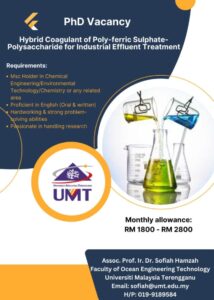
5. PhD in Environmental Technology: Wastewater Treatment (Universiti Malaysia Terengganu)
The Faculty of Ocean Engineering Technology is recruiting a PhD student specializing in wastewater treatment.
Research Focus
The PhD project aims to advance wastewater treatment technologies by exploring innovative methods to improve treatment efficiency, reduce environmental impact, and support sustainable water management.
Academic and Regional Significance
Situated within a faculty specialising in ocean engineering technology, the programme benefits from strong expertise in marine and environmental systems. The research contributes both to regional water management challenges and to the global body of environmental engineering knowledge.
Graduates of this programme are well positioned for careers in environmental consulting, academic research, water utilities, and policy-driven sustainability initiatives.
-
Supervisor: AP Ir Dr. Sofiah Hamzah.
-
Requirement: Submit CV to sofiah@umt.edu.my
-
Deadline: January 26th, 2026.
6. Postdoc in Sonochemical Reaction Engineering (University of Oxford)
Oxford University is recruiting a Research Associate to join James Kwan’s Physical Acoustics Lab. This role focuses on the conversion of air and water into nitrogenous compounds (fertilizer) using sonochemistry.
Research Scope and Objectives
This position involves experimental and technological development aimed at converting air and water into nitrogenous compounds suitable for fertiliser production. Key aspects include:
Optimisation of bespoke sonochemical reactors
Investigation of non-thermal reaction mechanisms
Catalyst development and performance characterisation
Advanced physical and chemical analysis
Contribution to translational research and potential commercial spin-outs
Skills and Career Development
The postdoctoral researcher will develop expertise in reaction engineering, catalysis, acoustics, and experimental design. The role also involves project management, collaboration with funding bodies, and mentoring within a multidisciplinary research environment.
Core Responsibilities:
-
Optimize sonochemical nitrogen fixation for a potential university spinout.
-
Utilize bespoke reactors and physical characterization tools.
-
Salary: £39,424 – £47,779 per annum.
Deadline: January 26th, 2026.
Apply: Oxford University Recruitment
Informal enquiries may be addressed to James Kwan (email: james.kwan@eng.ox.ac.uk)
Contact Person : Professor James Kwan Vacancy ID : 184251
Contact Phone : Closing Date & Time : 26-Jan-2026 12:00
Pay Scale : RESEARCH GRADE 7 Contact Email : james.kwan@eng.ox.ac.uk
Salary (£) : £39,424 – £47,779 per annum
7. Canada Impact+ Research Training Awards (CIRTA) – Dalhousie University
The Davenport Huyer Lab is recruiting international PhD students and Postdocs to move to Canada and research the interface of polymer chemistry, biomaterials, and immunology.
Research Themes
Immune-interactive biomaterial design
Immunometabolic profiling at biomaterial interfaces
Fibrotic pathology and immune response modulation
Advanced cellular, metabolic, and multi-omic analysis
Computational approaches to immunophenotyping
Training Environment and Outcomes
Trainees benefit from interdisciplinary mentorship, access to clinical and industry-adjacent collaborations, and a strong track record of high-impact research outputs. These fellowships are particularly suited for candidates aiming to build international research careers in biomedical science and translational materials research.
Funding Levels:
-
PhD: $40,000/year (3 years).
-
Postdoc: $70,000/year (2 years).
Desired Backgrounds:
-
Polymer science, Biomedical engineering, or Immunology.
-
Interest in immunometabolic function and fibrotic pathology.
Deadline: January 26th, 2026.
Contact: l.davenporthuyer@dal.ca | Lab Website
📅 Application deadline: January 26
📩 Interested candidates are encouraged to reach out directly (email: l.davenporthuyer@dal.ca) with a brief statement of interest and CV. I’m happy to discuss project fit and CIRTA eligibility.
Please share with strong candidates in your networks.
https://www.davenporthuyerlab.com/
2026 Application Deadlines
| Role | Institution | Key Field | Deadline |
| PhD | Radboud University | Green Ammonia | Ongoing |
| PhD | UC Dublin | Biomaterials | Feb 20, 2026 |
| PhD | UMT Malaysia | Wastewater | Jan 26, 2026 |
| PhD/Postdoc | Dalhousie Univ | Immunology/Polymers | Jan 26, 2026 |
| Postdoc | Utrecht Univ | Coastal Plastics | Mar 2, 2026 |
| Postdoc | Oxford Univ | Sonochemistry | Jan 26, 2026 |
| Volunteer | SPOT Cyprus | Turtle Conservation | Jan 30, 2026 |
Strategies for a Successful Application
To succeed in these high-stakes applications, candidates must go beyond traditional academic achievement.
The “Builder” Mindset
Institutions like Oxford and Radboud are prioritizing candidates who understand scientific instrumentation. If you have experience building custom probes, sensors, or automated scripts in Python, emphasize these in your CV.
Interdisciplinary Language
In 2026, the best researchers “speak” multiple scientific languages. For the UCD position, for example, your ability to discuss both mechanical stress models and cell signaling pathways will be your greatest asset.
Sustainability & Societal Impact
Funding bodies (like NWO Vidi and Vici) are increasingly looking for research that directly addresses the UN Sustainable Development Goals. Ensure your motivation letter clearly outlines how your work will lead to a cleaner environment or better healthcare outcomes.