



✅ Stay ahead of the 2025 Analytical Method Validation (AMV) updates shaping global pharma quality. Learn how ICH Q2(R2), USP <1225>, and EU-GMP Annex 15 introduce new rules for specificity, precision, linearity, robustness, and lifecycle management. Ensure your lab remains audit-ready and compliant with the latest international validation standards for analytical excellence.
Analytical Method Validation (AMV) 2025: The Ultimate Article to Pharma’s New Regulatory Standards
Analytical Method Validation (AMV) stands as the scientific backbone of every quality-controlled pharmaceutical operation. It ensures that every analytical procedure — from identifying impurities to quantifying APIs — delivers accurate, reliable, and reproducible results. However, with global regulations evolving rapidly, traditional validation practices no longer suffice. The year 2025 marks a turning point, where regulators demand not only compliance but also deeper scientific understanding and lifecycle-based control of analytical methods.
Under the updated guidelines — ICH Q2(R2), USP <1220>/<1225>, EU-GMP Annex 15, and ICH Q14 — AMV now mandates specificity, robustness, and statistical precision as integral requirements, transforming how laboratories design, validate, and maintain analytical methods.
Overview of Analytical Method Validation
Analytical Method Validation defines the scientific evidence proving that an analytical method is suitable for its intended purpose. Whether analyzing drug potency, impurities, or dissolution, validation ensures data integrity and patient safety.
The core parameters include:
- Specificity
- Accuracy
- Precision
- Linearity and Range
- Detection and Quantitation Limits (LOD/LOQ)
- Robustness
- System Suitability Testing (SST)
Regulatory bodies — FDA, EMA, WHO, and ICH — now view AMV as a continuous lifecycle process, not a one-time experiment.
Why the 2025 Updates Matter
The new ICH Q2(R2) revision emphasizes data-driven decision-making and risk-based validation. Meanwhile, ICH Q14 and USP <1220> align method validation with product lifecycle management (PLM).
Key 2025 AMV Trends
- Lifecycle validation: Emphasis on maintaining validation through method changes.
- Deeper specificity: Proof of separation between analyte and degradation products.
- Tighter precision: Reduced RSD thresholds across assays and impurities.
- Mandatory robustness: Statistical justification through DoE (Design of Experiments).
- Digital traceability: Documentation, audit trails, and trending in LIMS/QMS.
1. Specificity: From Optional to Mandatory
Specificity, once considered a qualitative evaluation, is now non-negotiable in 2025.
Old Vs New
- Before 2025: Checked for interference only.
- Now: Must include forced degradation studies under stress (acid, base, oxidation, heat, light).
What’s Required
- Peak Purity ≥ 0.99 (HPLC/UPLC chromatograms).
- Orthogonal confirmation using LC-MS, GC, or spectroscopic methods.
- Forced degradation on API and formulation.
Best Practice: Overlay chromatograms from all stressed samples. Include degradation profile, recovery, and purity index.
2. Precision and Linearity: Stricter Statistical Demands
Precision
Precision now represents statistical reliability, not just repeatability.
- Previous acceptance: %RSD ≤ 2.0%
- 2025 update:
- Assay: %RSD ≤ 0.999
- Impurities: Even stricter thresholds.
- Intermediate precision across analysts and instruments is mandatory.
Linearity
Calibration curves must now achieve near-perfect correlations.
- Assay: R² ≥ 0.9999
- Impurities: R² ≥ 0.9995
Validation Tip
Use validated regression models and report slope, intercept, and bias. Regulators now inspect raw regression outputs for traceability.
3. Accuracy: Refined Recovery Ranges
Accuracy measures how close results are to the true value.
Updated Acceptance Criteria (2025):
- Assay: 98.0% – 102.0%
- Impurities:
- Near LOQ: 70–130%
- Near Specification: 80–120%
- High Level: 90–110%
- Dissolution: 95–105%
Each level requires triplicate recoveries and full statistical justification.
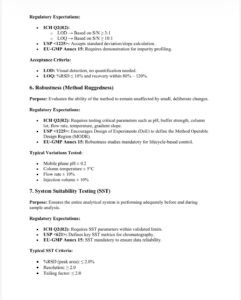
4. Robustness: The New Lifecycle Mandate
Once a “recommended” test, robustness is now compulsory.
Regulatory Basis
- ICH Q2(R2)
- ICH Q14
- EU-GMP Annex 15
Typical Parameters
- Flow rate (±10%)
- Mobile phase pH (±0.2)
- Temperature (±5°C)
- Injection volume (±10%)
Use DoE (Design of Experiments)
Design factorial studies to map how each parameter affects output (resolution, tailing, area). Define a Method Operable Design Region (MODR).
5. Detection and Quantitation Limits (LOD/LOQ)
2025 brings stricter LOQ proofing.
- LOD: S/N ≥ 3:1
- LOQ: S/N ≥ 10:1, with recovery validation.
- LOQ Recovery: 80–120%, RSD ≤ 10%.
Include both signal-to-noise and calibration curve methods to justify LOD/LOQ scientifically.
6. Solution Stability and Filter Compatibility
Analytical results are meaningless without stable and compatible sample solutions.
Requirements
- Solution Stability: Prove analyte integrity for 24–72 hours.
- Filter Compatibility: ≤ 2% deviation between filtered and centrifuged samples.
- Mandatory for: All quantitative methods (assay, impurity, dissolution).
7. System Suitability Testing (SST)
SST ensures the system is fit before analysis.
Key Parameters (2025):
- %RSD (peak area): ≤ 2.0%
- Resolution: ≥ 2.0
- Tailing factor: ≤ 2.0
- Theoretical plates: ≥ 2000
New Expectation
Trend SST data monthly. Record failures, CAPAs, and trending graphs for audit readiness.
Dissolution Method Validation
Dissolution is now a science-based validation discipline.
Key 2025 Requirements:
- Medium justification & deaeration proof.
- Hydrodynamic condition verification.
- USP Performance Verification Test (PVT) compliance.
- Filter adsorption and stability studies mandatory.
2024 Vs 2025 AMV Comparison
| Parameter | 2024 Standard | 2025 Update |
|---|---|---|
| Specificity | Simple interference check | Forced degradation + peak purity ≥ 0.99 |
| Precision | RSD ≤ 2.0% | RSD ≤ 0.999 |
| Linearity | R² ≥ 0.995 | R² ≥ 0.9999 |
| Robustness | Optional | Mandatory with DoE |
| Accuracy | Basic recovery | Layered impurity-specific recovery |
| LOD/LOQ | Optional recovery | Mandatory recovery at LOQ |
| SST | Routine check | Continuous trending |
| Solution Stability | Partial | Full lifecycle inclusion |
Best Practices for Audit-Ready AMV Documentation
- Automate data recording through LIMS/QMS.
- Version control SOPs — clearly identify updated sections.
- Include MODR studies in validation reports.
- Use cross-functional reviews (QA + Analytical + Regulatory).
- Maintain traceable raw data in electronic archives.
FAQs: Expert Insights
Q1: How should we plan for forced degradation studies?
A: Cover acid, base, oxidative, photolytic, and thermal conditions. Ensure 10–30% degradation.
Q2: How do I justify MODR statistically?
A: Use ANOVA from DoE to define ranges with consistent performance.
Q3: Is robustness required for all methods?
A: Yes — it’s mandatory across all critical methods, not just assays.
Q4: What if legacy methods lack LOQ recovery data?
A: Revalidate or supplement with addendum studies to meet ICH Q2(R2).
Transforming Compliance into Excellence
The 2025 Analytical Method Validation updates are not just rule changes — they represent a shift toward science-led, data-backed, and lifecycle-managed quality systems. By adopting forced degradation, DoE-based robustness, and statistical precision, your lab doesn’t just meet regulations — it builds credibility and trust.
The path forward:
- Reassess all existing methods.
- Revalidate with new criteria.
- Implement DoE and digital documentation.
In 2025 and beyond, method validation is not a task—it’s a culture of continuous scientific excellence.