Fully Funded PhD Opportunities 2025–2026 in Engineering, Biotechnology, Energy, and Sustainable Development (Global)
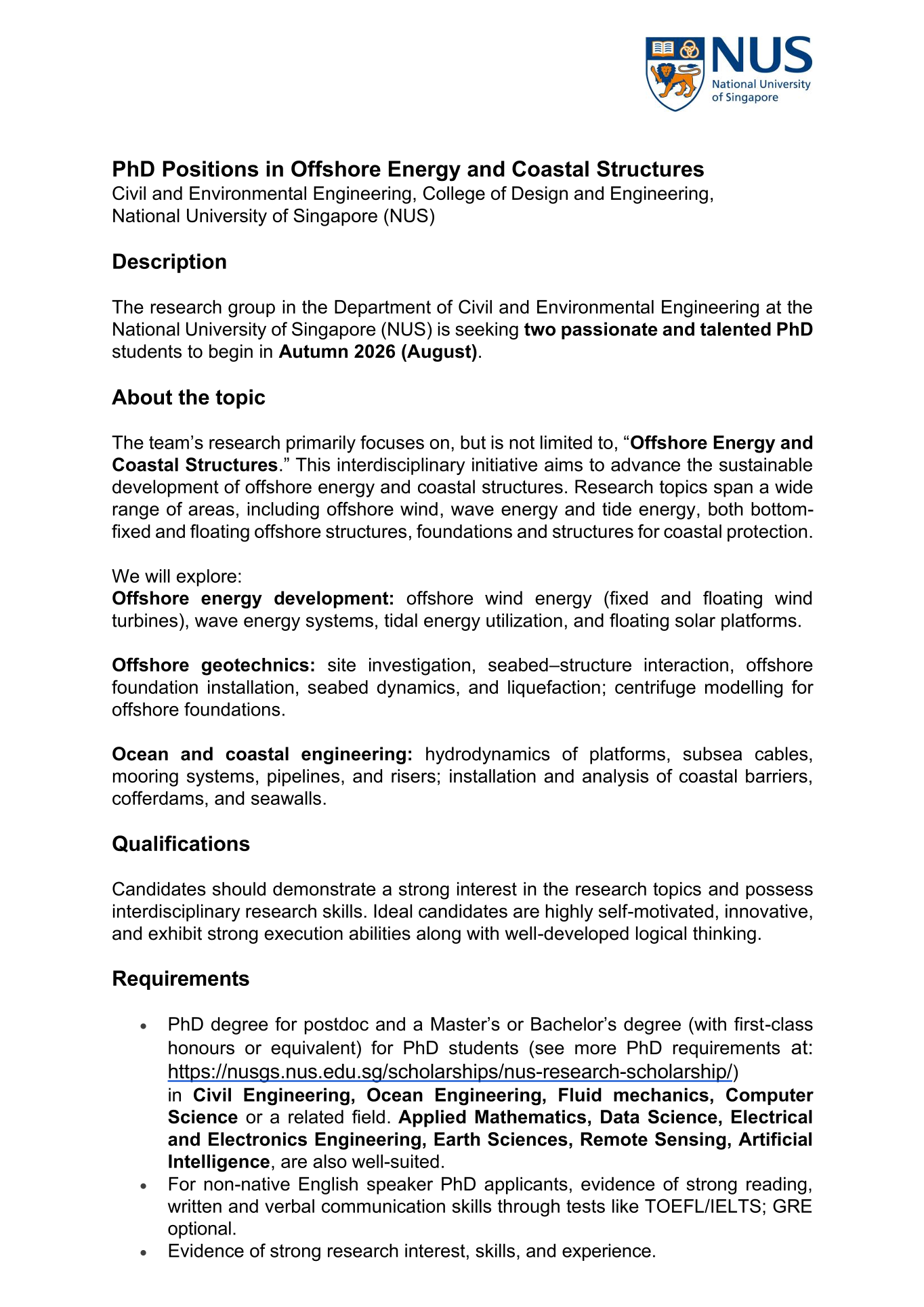
1) Fully Funded PhD Positions in Offshore Energy and Coastal Structures at NUS – Autumn 2026 Intake
The National University of Singapore (NUS), recognized globally as one of the world’s leading research-intensive universities, is proud to announce the availability of two fully funded PhD positions. These prestigious doctoral research opportunities are specifically targeted toward the critical, future-facing field of Offshore Energy and Coastal Structures. These positions are hosted within the highly-regarded Department of Civil and Environmental Engineering, part of the College of Design and Engineering. The successful candidates are expected to commence their studies in the Autumn 2026 intake, specifically the August academic cycle.
The Strategic Importance of Offshore Energy and Coastal Structures Research
The twin challenges of climate change and the global energy transition necessitate advanced, innovative solutions in marine and coastal engineering. Research in Offshore Energy and Coastal Structures is fundamentally interdisciplinary, drawing upon principles of civil engineering, oceanography, geotechnics, fluid mechanics, and material science to design, build, and maintain resilient marine infrastructure. These PhD positions are tailored for highly motivated, talented, and academically distinguished candidates who are passionate about contributing to a sustainable and secure future. The research conducted by the selected students will be high-impact, addressing real-world engineering challenges, and contributing meaningfully to global efforts in renewable energy and coastal protection.
Detailed Research Focus Areas for the PhD Candidates
The selected PhD candidates will engage in cutting-edge research under the broad umbrella of Offshore Energy and Coastal Structures. The research is structured around three interconnected, critical application domains, offering ample opportunities for both theoretical and applied engineering innovation.
I. Offshore Energy Systems and Technology
This domain is directly aligned with the global transition toward renewable and low-carbon energy sources. Research topics are inherently multidisciplinary and focus on the deployment and optimization of marine-based energy generation technologies.
-
Offshore Wind Energy Systems: This includes both fixed-bottom and advanced floating offshore wind turbine (FOWT) designs. Research may encompass structural dynamics, fatigue life assessment, aerodynamic-hydrodynamic-geotechnical coupled analysis, and optimization of substructures (e.g., monopiles, jackets, semisubmersibles).
-
Wave and Tidal Energy Utilization: Investigating the design, efficiency, and environmental impact of various Wave Energy Converters (WECs) and tidal energy harnessing technologies. This involves complex fluid-structure interaction modeling and energy yield assessment.
-
Floating Solar Platforms (Floatovoltaics): Research on the hydro-elastic response, mooring system design, and overall resilience of large-scale solar arrays deployed in offshore or sheltered marine environments. The emphasis is on maximizing power generation while ensuring structural integrity in harsh conditions.
II. Offshore Geotechnics and Foundation Engineering
The stability and longevity of any offshore structure fundamentally depend on robust foundation design in the challenging marine subsurface environment. This research area employs advanced modeling, laboratory testing, and field data analysis to address complex soil-structure interaction issues.
-
Seabed-Structure Interaction Modeling: Developing advanced constitutive models for marine soils and conducting numerical simulations (e.g., using Finite Element or Finite Difference methods) to accurately predict the performance of foundations under various loading conditions (e.g., cyclic, monotonic, seismic).
-
Offshore Foundation Design and Installation: Focused research on novel foundation types, including suction caissons, driven piles, gravity-based structures (GBS), and advanced anchor systems for floating platforms. This includes studying installation processes and mitigating installation risks.
-
Seabed Dynamics and Liquefaction: Investigating the dynamic behavior of the seabed under environmental loads (e.g., waves, currents, earthquakes), particularly focusing on the potential for soil liquefaction and its impact on infrastructure stability.
-
Advanced Centrifuge Modeling: Utilizing NUS’s state-of-the-art geotechnical centrifuge facility for physical modeling of offshore foundation performance, offering a powerful tool for validating numerical models and understanding complex physical mechanisms at a reduced scale.
Ocean and Coastal Engineering for Climate Resilience
This area focuses on the environmental dynamics of the ocean and the critical infrastructure necessary to protect coastal regions from hazards associated with climate change, such as sea-level rise and increased storm intensity.
-
Hydrodynamics of Offshore Platforms and Subsea Systems: Analyzing the wave, current, and wind loading on large offshore structures, including semisubmersibles, Tension Leg Platforms (TLPs), Spars, and the dynamics of critical subsea infrastructure like subsea cables, mooring lines, pipelines, and risers.
-
Coastal Protection Structures and Climate Adaptation: Research on the design, performance, and long-term assessment of various coastal defense mechanisms, including seawalls, breakwaters, revetments, cofferdams, and nature-based solutions. This work is essential for enhancing coastal sustainability and mitigating erosion.
-
Marine and Coastal Infrastructure Resilience: Developing methodologies for assessing the structural health and operational resilience of existing coastal and offshore infrastructure against extreme weather events and long-term environmental degradation.
PhD Positions, Scholarship, and Supervision
NUS is explicitly seeking to recruit two exceptional PhD candidates for the Autumn 2026 intake. The successful applicants will be awarded a full scholarship, which is a significant component of this prestigious opportunity.
-
Scholarship Coverage: The full scholarship typically encompasses the coverage of the complete PhD tuition fees, ensuring no financial burden related to academic costs. Additionally, the scholarship provides a competitive monthly stipend for living expenses, aligning with the generous rates of the standard NUS Research Scholarship guidelines. This financial package is designed to allow the student to dedicate their entire focus to the demanding doctoral research and academic program. The stipend is often enhanced for candidates who have demonstrated outstanding research capability and are Singapore citizens or Permanent Residents, though international applicants are fully encouraged to apply and receive the standard competitive stipend.
-
Supervision and Research Environment: The selected students will be supervised by Dr. Shengjie Rui, an Assistant Professor in the Department of Civil and Environmental Engineering at NUS. Dr. Rui is an internationally recognized expert in offshore geotechnics, foundation engineering, and coastal structure dynamics, with a strong track record of high-impact publications and extensive collaboration with leading academic institutions and industry partners globally. The supervision style emphasizes developing independent research capabilities, critical thinking, and advanced technical skills in the students. The research lab provides a highly collaborative, international, and stimulating environment, with access to world-class laboratory facilities, advanced computational resources, and a strong network of academic and industry collaborators.
Desired Academic Background and Candidate Profile
Successful applicants are typically individuals who have demonstrated outstanding academic excellence and possess a foundational knowledge relevant to the research areas. The interdisciplinary nature of the research means that candidates from a range of engineering and science backgrounds are encouraged.
Minimum Academic Requirements
Applicants must hold or expect to shortly obtain a Bachelor’s degree (with Honors or equivalent, such as a First Class or Second Class Upper Division) or a Master’s degree.
Relevant Academic Disciplines Include:
-
Core Engineering: Civil Engineering, Ocean Engineering, Offshore Engineering, Mechanical Engineering.
-
Fundamental Sciences: Fluid Mechanics, Applied Mathematics, Earth Sciences, Remote Sensing.
-
Emerging Technologies: Computer Science, Data Science, Artificial Intelligence (AI), Electrical or Electronics Engineering (especially relevant for sensor technology, data acquisition, and system control in offshore platforms).
Key Desired Attributes and Skills
Candidates who possess or are willing to rapidly develop the following skills will be highly competitive:
-
Analytical and Problem-Solving Ability: A robust theoretical understanding of engineering and scientific principles, coupled with a strong capacity for analytical and quantitative problem-solving.
-
Research Experience: Prior experience in academic research (e.g., a Master’s thesis, strong Bachelor’s final year project, or research internship) resulting in a publication or significant report is a distinct advantage.
-
Computational and Programming Proficiency: Demonstrable proficiency in essential programming languages and tools for engineering analysis and data processing is highly valued. Key tools include:
-
Python: For machine learning, data processing, and automation.
-
MATLAB: For numerical computation, matrix operations, and visualization.
-
Finite Element Software: Experience with commercial or open-source finite element (FE) or finite difference (FD) software (e.g., ABAQUS, ANSYS, Plaxis) relevant to geotechnical or structural analysis.
-
-
Communication Skills: Excellent written and oral English communication skills are mandatory for success in research, publication, and collaborative work.
-
Interdisciplinary Interest: A genuine interest in integrating engineering principles with data science, environmental sustainability, and complex system modeling.
The Application Process and Critical Deadline
Interested candidates are strongly advised to initiate their application process as early as possible. Successful admission to a prestigious institution like NUS, particularly with a full scholarship, requires careful preparation and timely submission of all required materials.
-
Initial Contact and Informal Inquiry: Prospective applicants are strongly encouraged to contact Dr. Shengjie Rui directly via email with their CV, academic transcripts, and a brief statement of research interest. This allows for early assessment and discussion of potential research alignment before the formal application submission.
-
Formal Application: The formal application must be submitted through the official NUS graduate admissions portal for the Department of Civil and Environmental Engineering, indicating the desired August (Autumn) 2026 intake.
-
Required Documentation: Typically includes academic transcripts, degree certificates, detailed CV, research proposal (or statement of interest), proof of English proficiency (e.g., TOEFL or IELTS scores, if applicable), and referee reports.
-
Official Application Deadline: The formal submission deadline for the Autumn 2026 intake for these positions is 30 December 2025. Early contact and submission are highly recommended to maximize the chance of consideration.
Why Choose the National University of Singapore (NUS)?
Pursuing a PhD at NUS offers an unparalleled advantage for building a globally competitive research career. NUS consistently ranks among the top universities worldwide and is particularly renowned for its engineering and technology programs.
-
Global Reputation and Rankings: NUS is consistently ranked highly in global university league tables, often placing among the top institutions in Asia and the world. The Civil and Structural Engineering discipline at NUS is frequently ranked in the global top ten, providing a globally recognized credential.
-
Cutting-Edge Facilities: PhD candidates benefit from access to state-of-the-art research infrastructure, including advanced geotechnical laboratories (e.g., the Geotechnical Centrifuge Facility), wave flumes, structural testing facilities, and high-performance computing clusters.
-
International Research Environment: The campus is highly diverse, fostering a multicultural and international research environment. Students have opportunities for research exchanges, international conference attendance, and collaboration with leading researchers globally.
-
Industry and Policy Relevance: NUS maintains strong, active links with major offshore energy companies, governmental agencies (e.g., PUB, MPA), and coastal management authorities. This ensures that the research conducted is not only academically rigorous but also policy-relevant and has direct industry application, enhancing the employability and impact of its graduates.
-
Vibrant Ecosystem: Singapore’s position as a global hub for technology, finance, and logistics provides a unique ecosystem for research translation and networking, particularly in the marine and offshore technology sector.
Additional PhD Opportunities in Related Fields (Non-NUS)
While the NUS opportunity is highly specific, prospective doctoral candidates interested in related areas of sustainable development, biotechnology, and advanced diagnostics may also consider the following exciting, fully funded, or highly subsidized PhD opportunities, demonstrating the breadth of current global research needs.
Opportunity 2: Genetic Engineering for Biotechnology (Bennett University, India)
Bennett University is offering a PhD opportunity focused on a key area of medical biotechnology.
PhD – Genetic Engineering of L-Asparaginase (Bennett University)
🔗 Apply / Program Page:
https://www.bennett.edu.in/programs/phd/
📧 CV Email:
mailto:saurabh.sarma@bennett.edu.in
-
Research Focus: “Genetic Engineering of L-asparaginase.” This project involves molecular biology, protein engineering, and potentially industrial biotechnology to enhance the therapeutic properties of the enzyme L-asparaginase, which is critical in cancer treatment (e.g., Acute Lymphoblastic Leukemia).
-
Fellowship: A competitive, highly attractive fellowship of Rs. 40,000/- per month is available for an initial duration of 3 years, with a possible extension for a fourth year based on demonstrated performance and research progress.
-
Eligibility: M.Tech or M.Sc. students from backgrounds such as Biotechnology, Biochemistry, Microbiology, or related life science and engineering disciplines.
-
Application Process: Candidates should apply online through the official Bennett University website’s admissions portal. A copy of the Curriculum Vitae (CV) should also be sent directly to the concerned faculty member: saurabh.sarma@bennett.edu.in.
-
Application Deadline: The closing date for online applications is 31st December 2025.
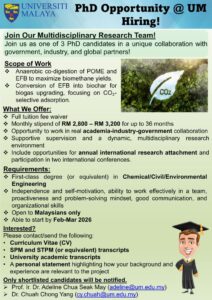
Opportunity 3: Bioresource Engineering for Biomethane and Biochar (University of Malaya, Malaysia)
A fully funded PhD position is available at the University of Malaya (UM), focusing on sustainable waste-to-energy conversion, specifically utilizing Palm Oil Mill Effluent (POME) and Empty Fruit Bunches (EFB), highly relevant to sustainable agricultural practices in Southeast Asia.
Fully Funded PhD – Bioenergy & Biogas (University of Malaya)
📧 CV Submission Emails:
mailto:adeline@um.edu.my
mailto:cy.chuah@um.edu.my
🌐 University of Malaya (Reference):
https://www.um.edu.my/
-
Project Themes: The research is split into two complementary tracks:
-
Anaerobic Co-digestion: Maximizing biomethane yields through the co-digestion of POME and EFB, an essential step for scaling up renewable natural gas production from waste streams.
-
Biochar for Biogas Upgrading: Converting EFB into specialized biochar (a carbonaceous material) to be used for the selective adsorption and removal of Carbon Dioxide ($\text{CO}_2$) from raw biogas, thereby upgrading it to pipeline-quality biomethane.
-
-
Funding: This is a fully funded position, which typically covers tuition and provides a living stipend as per UM’s graduate research scheme.
-
Supervisory Team: Prof Adeline Seak May Chua, Dr Santheraleka Ramanathan, and another faculty member (unspecified in the brief).
-
Required Attributes: Candidates must possess a First-class degree (or equivalent, e.g., CGPA of 3.67/4.00 or above) in a relevant engineering discipline, such as Chemical Engineering, Civil Engineering, or Environmental Engineering. Key soft skills include independence, strong communication, teamwork, and a proactive problem-solving mindset.
-
Application Procedure: Interested applicants should submit their comprehensive CV, complete academic transcripts, and a detailed personal statement (outlining research interests and motivation) to the principal supervisors: adeline@um.edu.my and cy.chuah@um.edu.my. Final year undergraduate students who expect to achieve a first-class degree are also encouraged to apply.
-
Application Deadline: The final date for applications is 15th January 2026.
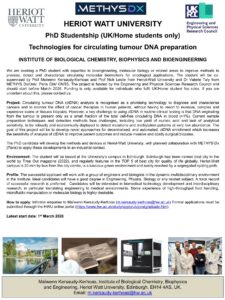
Opportunity 4: Circulating Biomarkers and Cancer Diagnostics (Heriot-Watt University, UK)
A highly urgent, funded PhD position in biomedical engineering and diagnostics, co-supervised internationally, is available for UK/Home students only. This project is focused on revolutionizing cancer diagnosis through advanced molecular biomarker detection.
Fully Funded PhD – ctDNA Cancer Diagnostics (Heriot-Watt University, UK – Home Students Only)
🔗 Eligibility (UKRI Home Students):
https://www.ukri.org/what-we-do/developing-people-and-skills/esrc/funding-for-postgraduate-training-and-development/eligibility-for-studentship-funding/
🔗 Formal Application Portal (HWU):
https://www.hw.ac.uk/study/how-to-apply/postgraduate-programmes
📧 Informal Enquiry Email:
mailto:m.kersaudy-kerhoas@hw.ac.uk
-
Project Goal: Developing novel, decentralized, and automated approaches for the enrichment and analysis of circulating tumour DNA (ctDNA). The primary objective is to increase the analytical sensitivity for detecting low-abundance ctDNA mutations and methylation patterns, which will improve patient outcomes and reduce the need for invasive, costly tissue biopsies.
-
Funding and Stipend: The project is funded by the UK’s Engineering and Physical Sciences Research Council (EPSRC). Funding is strictly limited to individuals who meet the UK/Home student fee eligibility criteria. The position provides a substantial annual tax-free stipend of approximately £20,000 for $3.5$ years.
-
Supervision: The student will be co-supervised by Dr. Maïwenn Kersaudy-Kerhoas (Heriot-Watt University), Prof Nick Leslie (Heriot-Watt University), and Dr. Valerie Taly (METHYS Dx/Univ. Paris Cité/CNRS), involving collaboration with METHYS Dx for industrial translation.
-
Desired Background: Expertise in Engineering, Bioengineering, Molecular Biology, or related fields. Experience in robotics, mechanical engineering, high-throughput fluid handling, microfluidic manipulation, or molecular biology is highly desirable. A track record of successful research is preferred.
-
Start Date: The project has an urgent start date, scheduled for March 2025.
-
Application Procedure: Informal inquiries regarding eligibility and the project scope should be directed to Dr. Maïwenn Kersaudy-Kerhoas (m.kersaudy-kerhoas@hw.ac.uk). Formal applications must be submitted via the official Heriot-Watt University online portal.
Opportunity 5: Sustainable Development Doctoral Program (University of Notre Dame, USA)
The prestigious University of Notre Dame’s Keough School of Global Affairs is inviting applications for its fully funded PhD in Sustainable Development, emphasizing interdisciplinary, policy-relevant research.
Fully Funded PhD – Sustainable Development (University of Notre Dame, USA)
🔗 Program Page (Direct Apply Info):
https://keough.nd.edu/academics/phd-program/ph-d-in-sustainable-development/
🔗 University Sustainability & Research Initiatives:
https://strategicframework.nd.edu/initiatives/
-
Program Focus: This is an interdisciplinary, STEM-designated program that aims to train scholars and leaders to address complex global challenges related to the flourishing of people and the planet. Research covers a wide range of issues, including conservation, pollution, climate change, environmental governance, poverty, inequality, and the achievement of the Sustainable Development Goals (SDGs).
-
Financial Support: The program offers comprehensive financial support, including a full tuition scholarship, an annually renewable 12-month stipend for living expenses, a health insurance subsidy, and up to $4,000 for professional development and conference travel.
-
Interdisciplinary Nature: The program leverages resources across the social sciences, business, and engineering, providing a unique platform for engaged scholarship and team-based research, especially through the university’s major strategic initiatives on sustainability, democracy, and data sciences.
-
Application Procedure: Full details about the program and the application process are available on the official website for the Ph.D. in Sustainable Development at Keough School.
-
Priority Application Deadline: Applications are reviewed on a rolling basis, but those submitted by January 15, 2026, will receive priority consideration for admission and financial aid.