Top 2026 PhD and Postdoctoral research opportunities in AI, Agriculture, Geoscience, and Engineering across the USA, Canada, Australia, and Italy. Apply for fully funded positions and prestigious research grants today.
The landscape of higher education and advanced research is undergoing a significant transformation as we move into 2026. Academic institutions globally are prioritizing interdisciplinary studies, seeking to bridge the gap between theoretical frameworks and practical societal applications. For aspiring researchers and doctoral candidates, this era represents a golden window of opportunity to secure funding and join laboratories at the cutting edge of innovation. From the technological hubs of North America to the historic academic centers of Europe and the resource-rich research environments of Australia, the call for intellectual talent has never been more urgent.
Securing a PhD or Postdoctoral position is more than an academic milestone; it is a commitment to solving the world’s most pressing challenges. Whether it is the development of resilient AI systems, the optimization of agricultural productivity through mechatronics, or the exploration of critical minerals essential for the green energy transition, the roles available today are designed for those who possess both technical rigor and a visionary mindset.
1. Advanced Computing and Hardware Design at North Dakota State University
North Dakota State University (NDSU) is currently expanding its research footprint in the critical domains of device-circuit design and computer architecture. Under the leadership of Dr. Sumitha George, the research group is actively recruiting motivated MS and PhD students who are eager to push the boundaries of how we build and utilize hardware.
The primary research thrusts for this group include:
-
Device-Circuit Design: Exploring the intersection of physical hardware components and the logical circuits that drive modern electronics.
-
Computer Architecture: Developing new frameworks for processing power, efficiency, and reliability.
-
Cryogenic Computing: Investigating how computing systems behave and thrive at extremely low temperatures, a field vital for the future of quantum computing and high-performance data centers.
-
Hardware for Machine Learning: Creating specialized chips and architectures that can handle the massive computational loads required by modern AI and ML models.
-
Genomics Applications: Designing optimized hardware to accelerate DNA sequencing and biological data analysis.
Prospective students should have a strong background in electrical engineering, computer engineering, or a related field. The lab emphasizes a balance between theoretical innovation and practical building. Candidates interested in joining this group for the 2026 admission cycle are encouraged to reach out directly to Dr. George.
If you know interested candidates, please refer to me\
(subject line PhD/MS admission 2026).
Please reach me at sumitha.george@ndsu.edu
https://scholar.google.com/citations?user=6mmtcGkAAAAJ&hl=en
2. Agricultural and Biological Engineering at Mississippi State University
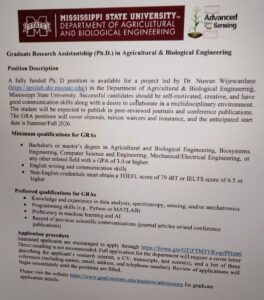
The intersection of technology and agriculture is one of the most vital sectors for global food security. Mississippi State University (MSU) is offering a Graduate Research Assistant (GRA) position within the Department of Agricultural and Biological Engineering for the Summer or Fall of 2026. This position, overseen by Dr. Nuwan Wijewardane, is ideal for students with a passion for mechatronics and sensing technologies.
The research focuses on the application of high-tech engineering solutions to biological systems. Key areas of interest include:
-
Mechatronics and Robotics in Agriculture.
-
Optical Engineering and Spectroscopy for plant and soil health monitoring.
-
Advanced Data Analytics and Sensing.
-
Programming and Algorithm Development for autonomous systems.
The application process is rigorous, requiring a consolidated PDF that includes a cover letter outlining specific research goals and relevant technical experience. Because this is a GRA position, the successful candidate will be expected to contribute significantly to ongoing research projects while pursuing their advanced degree. This role offers a unique opportunity to work in a field where engineering directly impacts environmental sustainability and agricultural efficiency.
If you have questions, please contact Dr. Nuwan Wijewardane (nuwanw@abe.msstate.edu)
Looking for student for a fully funded Ph. D position in my lab. If you are interested, please apply through: https://docs.google.com/forms/d/e/1FAIpQLSeKwMMuBKYBc5xmGgyggOCTFTe5dPiDol8EZgCczjBy1Ik80Q/viewform?pli=1. See the details below. Please share with anyone interested
3. Canada Impact+ Research Training Awards: A Gateway to Innovation
Canada has launched a landmark initiative to solidify its position as a global leader in research and development. The Canada Impact+ Research Training Awards, supported by the tri-agency council (CIHR, NSERC, and SSHRC), represent one of the most significant investments in human capital in recent years. This program aims to attract 600 doctoral scholars and 400 postdoctoral researchers to Canadian institutions over the next three years.
The financial support provided by these awards is substantial:
-
Doctoral Awards: $40,000 per year for a duration of three years.
-
Postdoctoral Awards: $70,000 per year for a duration of two years.
The program is specifically designed to attract international talent and encourage Canadian researchers currently abroad to return home. Priority research areas include Advanced Digital Technologies, AI Safety, Cybersecurity, Health, Biotechnology, and Climate Resilience.
At the University of Western Ontario, Dr. Apurva Narayan is actively seeking candidates whose work aligns with these strategic goals. Specifically, the lab is looking for expertise in AI Safety, Robust AI, and Responsible Innovation. This is a prestigious pathway for researchers who want to work in an environment that values both technological excellence and ethical responsibility. With the first round of nominations due in early 2026, early engagement with potential supervisors is critical.
📩 Interested or know someone who might be?
Send me a message or email me directly (apurva.narayan@uwo.ca) — let’s explore how your research fits into these strategic themes and how we can secure a nomination for you!
4. University of Sassari: 41st Cycle PhD Programmes in Italy
The University of Sassari (UNISS) in Italy has announced its call for applications for the 41st cycle of its PhD programs. This opportunity is perfect for students seeking to conduct research within the European Union’s academic framework. The university is offering positions across several high-impact disciplines:
-
Economics, Management, and Quantitative Methods: Focusing on the complexities of modern global markets and data-driven decision-making.
-
Life Sciences and Biotechnologies: Engaging with cutting-edge biological research and medical innovation.
-
Agricultural Sciences: Continuing Italy’s long tradition of excellence in agronomy and sustainable land management.
The deadline for these applications is strictly set for December 24, 2025. International students must ensure their documentation meets the Italian equivalency standards. These programs offer a vibrant academic culture and the chance to engage in research that benefits both the local Mediterranean region and the broader global community.
Applications must be submitted, on penalty of exclusion, by 1 pm of 24th December 2025 (CET) only by connecting to https://www.uniss.it/sites/default/files/2025-11/Bando%20ENG_0.pdf
Website: https://uniss.esse3.cineca.it/Root.do
5. Critical Minerals and Geoscience at the University of Tasmania
As the world shifts toward renewable energy, the demand for critical minerals like copper and cobalt has reached unprecedented levels. The University of Tasmania (UTAS), through the Centre for Ore Deposit and Earth Sciences (CODES), is offering a fully funded PhD project focused on sediment-hosted Cu-Co deposits.
Supervised by Dr. Matt Cracknell and his team, the project titled “Deposit-scale vectoring and global basin fertility of sediment-hosted Cu-Co deposits via resistate mineral chemistry footprints” aims to revolutionize how we find these essential metals. The project seeks to improve exploration tools by analyzing mineral chemistry footprints, a task that combines traditional geology with modern data science.
Ideal candidates should possess:
-
A background in economic geology or geochemistry.
-
Knowledge of sedimentary basin models.
-
Skills in Python or R for data analysis and machine learning.
-
A willingness to engage in fieldwork and collaborate with industry partners.
This position is open to both domestic and international applicants, with applications closing on February 1, 2026. Given the specialized nature of the research, candidates are required to submit a research proposal and a signed supervisory support form after discussing their suitability with Dr. Cracknell.
Strategies for a Successful Research Application
Applying for high-level PhD and Postdoctoral positions requires more than just a strong transcript. Candidates must demonstrate a clear alignment with the laboratory’s goals and a high degree of independent initiative.
-
Tailor the Cover Letter: Avoid generic statements. Mention specific papers published by the principal investigator (PI) and explain how your previous work bridges the gap to their current projects.
-
Technical Proficiency: For roles in AI, Engineering, or Geoscience, highlight your coding skills (Python, R, C++) and your familiarity with specialized software (MATLAB, GIS, CAD).
-
Research Proposal: If required, your proposal should be ambitious yet feasible. It should demonstrate a deep understanding of the current literature and identify a clear gap that your work will fill.
-
References: Choose references who can speak not just to your grades, but to your resilience, creativity, and ability to work in a team.
Apply: https://www.utas.edu.au/research/degrees/available-projects?id=12102
The year 2026 stands to be a transformative time for global research. Whether you are drawn to the silicon-level innovations at North Dakota State, the field-based geochemical studies in Tasmania, or the high-stakes AI safety research in Canada, the opportunities listed above provide a robust starting point for a distinguished career in academia and industry. By acting early and preparing a meticulous application, you can secure your place at the forefront of global innovation.