Explore top fully funded PhD openings for 2026 across North Dakota State University, Mälardalen University, Concordia University, Purdue Engineering, and more. Apply now for research in plant genomics, AI, sustainability, life-cycle analysis, computer vision, and light-matter interactions.
Global Funded PhD Research Opportunities 2026: AI, Genomics, Environmental Engineering, and Computer Vision
PhD programs have evolved beyond conventional disciplinary silos, welcoming interdisciplinary candidates who can blend science, technology, and innovation. The 2026 academic year presents exceptional global opportunities for aspiring researchers in areas such as plant genomics, artificial intelligence, sustainability engineering, optical materials, and computer vision. These positions combine strong academic mentoring, full funding, and cutting-edge research environments.
Whether your interests lie in understanding genetic resilience in crops, performing life cycle analysis of bio-based plastics, developing AI-driven systems, or exploring the frontiers of light–matter interactions, these openings will help shape the next generation of research leaders.
1. PhD in Crop Resilience and Multi-Omics — North Dakota State University (USA)
Overview
The Plant Genomics Lab at North Dakota State University (NDSU) is offering a fully funded PhD opportunity focused on uncovering the genetic and molecular mechanisms of crop resilience. The research integrates multi-omics, computational modeling, and high-throughput phenotyping to analyze how plants respond to environmental changes.
The position also includes opportunities to engage in AI-assisted genomics and computational biology, using machine learning tools to model gene–environment interactions.
Research Themes
- Genetic networks controlling stress tolerance in major crops
- Transcriptomics, proteomics, and metabolomics integration for resilience mapping
- Computational modeling for genotype-environment prediction
- AI and deep learning models for genomic and phenotypic data analysis
Candidate Profile
Applicants must have:
- A Master’s degree in Plant Science, Computational Biology, Genomics, or related fields
- Experience in Linux, R, or Python programming
- Knowledge in genomics/epigenomics and molecular biology techniques
- Strong motivation for interdisciplinary research
Candidates with experimental molecular backgrounds and a passion for computational analysis are especially encouraged to apply.
Application Process
Interested candidates should prepare:
- Cover letter including research interests and contact information for 2–3 referees
- Curriculum Vitae (CV) detailing academic and technical qualifications
Apply through the official NDSU application link.
Why This Program Stands Out
- Integrates wet-lab and computational research
- Exposure to AI-based bioinformatics projects
- Opportunity to publish in high-impact journals
- Supportive interdisciplinary environment
2. PhD in Life-Cycle Analyses of Bio-Based Plastics — Mälardalen University (Sweden)
Overview
At the School of Economics, Society, and Technology (EST) at Mälardalen University, Västerås, Sweden, a funded PhD position is available focusing on the Life Cycle Analysis (LCA) of bio-based plastics. This research aims to enhance the sustainability of advanced materials through in-depth environmental and energy modeling.
The doctoral project is part of Sweden’s broader commitment to circular economy innovation, combining engineering expertise, environmental analysis, and industrial collaboration.
Key Research Areas
- Life-cycle modeling of bioplastics
- Waste management and material recycling
- Environmental and energy efficiency assessment
- Industrial process analysis and optimization
Desired Qualifications
- MSc in Environmental or Chemical Engineering, or a related discipline
- Experience in LCA methodologies (OpenLCA, SimaPro)
- Familiarity with waste management, recycling, and materials reuse
- Proficiency in Matlab, Aspen Plus, or equivalent tools
- Strong English communication skills
Employment and Benefits
- Full-time fixed-term employment (4–5 years)
- Doctoral training + teaching responsibilities (up to 20%)
- Opportunity for industry collaboration and applied sustainability research
Application Deadline
December 9, 2025 — applications must include verified degree certificates and transcripts.
Apply at the official MDU portal.
Why Choose Mälardalen University
- Recognized for Energy and Environmental Engineering excellence
- Modern research ecosystem integrating academia and industry
- Sweden’s supportive international PhD employment model
- Strong focus on innovation and sustainable design
3. PhD in AI Optimization and Generative Models — USA (Fall 2026)
Overview
A leading research group is recruiting PhD students for Fall 2026 to explore mathematical foundations of AI, optimization, and generative modeling. This position suits candidates seeking to advance large-scale AI systems while maintaining ethical alignment, reliability, and interpretability.
Research Themes
- Foundations of Generative AI: LLMs, diffusion models, reasoning architectures
- AI Alignment: RLHF, DPO, RLVR methods
- Reinforcement Learning: theory and applications to intelligent agents
- Agentic AI and robotics through model-based optimization
Ideal Candidate
- Strong programming background (Python, PyTorch, TensorFlow)
- Knowledge of optimization and reinforcement learning
- Interest in aligning AI systems with human goals
Interested candidates should email CV and a short research statement to:
📧 saferraiucf@gmail.com
Why This Position Is Unique
- Work at the intersection of mathematics and AI innovation
- Contribute to next-gen LLM and VLM architectures
- Gain experience in AI alignment, a growing global focus
4. Funded MSc, PhD & Postdoc Positions — Computer Vision and AI-Driven Surgical Systems (Concordia University, Canada)
Overview
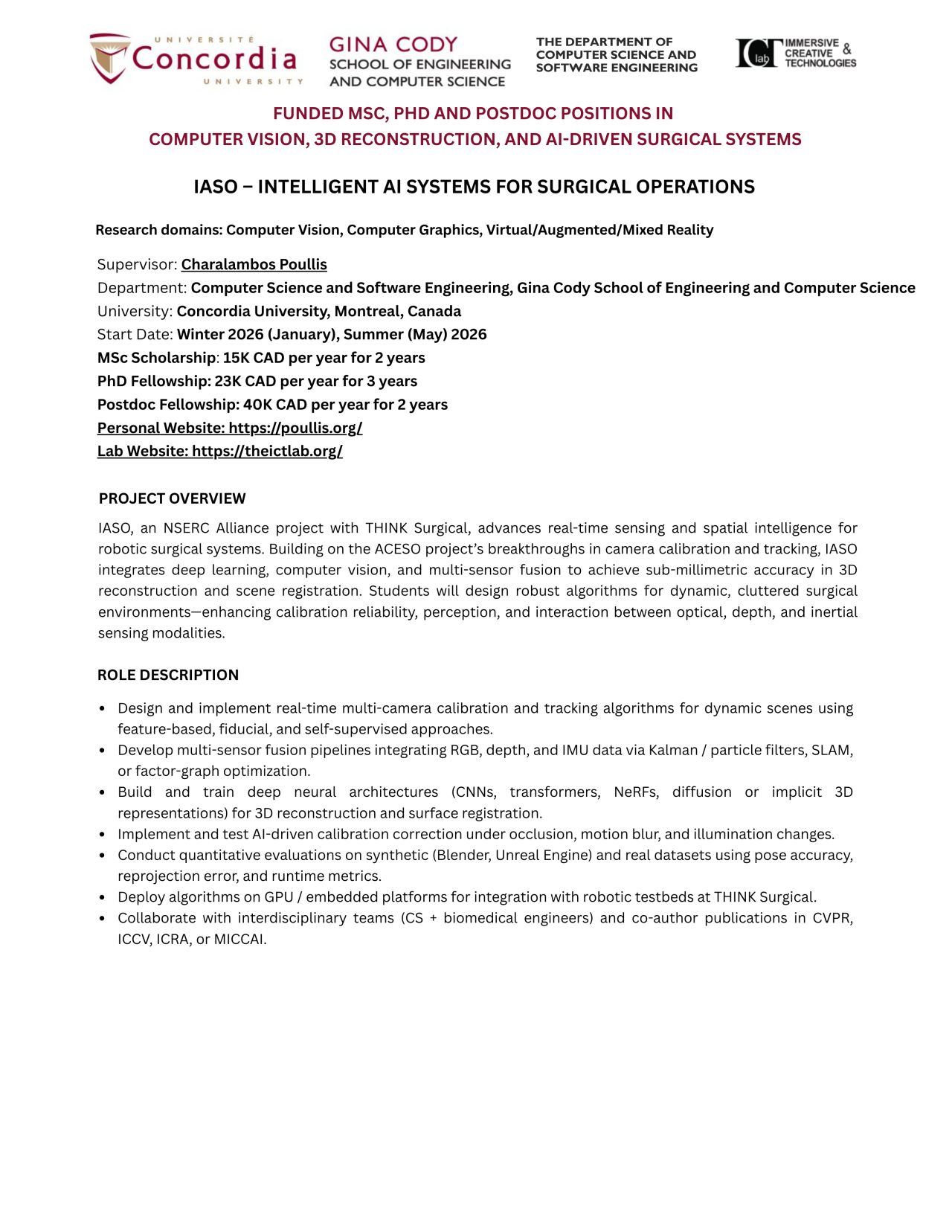
Professor Charalambos Poullis from the Immersive and Creative Technologies Lab, Concordia University, is offering fully funded positions in Computer Vision, 3D Reconstruction, and AI-driven Surgical Systems. These projects combine AI, robotics, and medical technology to advance next-generation surgical innovations.
Research Directions
- Real-time camera calibration and multi-view tracking
- Deep learning architectures (CNNs, transformers, NeRFs) for 3D reconstruction
- Sensor fusion: integrating RGB, depth, IMU data
- Medical imaging and augmented reality applications
Funding Packages
- MSc: 15,000 CAD/year (2 years)
- PhD: 23,000 CAD/year (3 years)
- Postdoc: 40,000 CAD/year (2 years)
Candidate Skills
- Experience in computer vision, machine learning, or robotics
- Proficiency in Python, PyTorch/TensorFlow, OpenCV
- Interest in real-time algorithms and AR/VR systems
Application
Apply via the Concordia information page.
Why Join This Lab
- Hands-on experience in medical robotics
- Collaborations with top researchers and hospitals
- Multi-disciplinary exposure: graphics, computer vision, and medicine
5. PhD in Opto-Thermo-Matter Interactions — Purdue University (USA)
Overview
Purdue Engineering is recruiting ambitious PhD candidates for research in light–matter and opto-thermo-matter interactions. The work involves experimental and theoretical studies in optical manipulation, advanced characterizations, and laser-based material processing.
Research Topics
- Nano-scale laser–material interactions
- Optical manipulation and force dynamics
- Nanoengineering and thermal transport
- Characterization of light-induced phenomena
Candidate Profile
- BTech/MTech/MSc in Mechanical Engineering, Materials Science, Optics, Physics, or related fields
- Strong background in experimental methods and laser instrumentation
- Interest in nanoengineering and materials physics
Application
Submit your CV and research interests to:
📧 jingang@purdue.edu
More info: Jingang Li Research
Why Choose Purdue
- Globally ranked in engineering and materials research
- Access to state-of-the-art laser labs
- Focus on multidisciplinary innovation and real-world applications
Comparative Overview of Opportunities
| University | Research Focus | Funding | Start Date | Application Method |
|---|---|---|---|---|
| North Dakota State Univ. | Crop resilience, multi-omics, AI genomics | Fully funded | Summer/Fall 2026 | Google Form |
| Mälardalen Univ., Sweden | LCA of bio-based plastics | Full-time employment | By agreement (deadline Dec 9, 2025) | ReachMee Portal |
| UCF (AI Optimization Group) | Generative AI, RL, alignment | Funded | Fall 2026 | |
| Concordia Univ., Canada | AI surgical systems, 3D reconstruction | MSc/PhD/Postdoc fellowships | 2026 | Official PDF link |
| Purdue Univ., USA | Opto-thermo matter interactions | Fully funded | Fall 2026 | Email Professor |
Tips for Applying to Global PhD Positions
- Tailor every application. Mention specific methods or instruments used in the target lab.
- Show interdisciplinary potential. Link your background (e.g., computational + experimental).
- Highlight research independence. Supervisors value candidates who can self-initiate experiments or models.
- Demonstrate coding or analytical expertise. Python, R, MATLAB, or software tools like OpenLCA add major value.
- Engage early. Contact supervisors ahead of formal applications.