Funded PhD & Research Openings — Soil Science, Energy Systems, Waste Valorization, Protein Chemistry & Computational Chemistry
Discover funded PhD, Postdoc and Research Assistant openings across Europe, India, and the USA in soil science, biogeochemistry, power converters, waste valorization to smart biopolymers, and protein/computational chemistry. Deadlines, eligibility, application tips, funding details, and action steps to apply for positions at ETH Zürich, Ghent University, Wageningen, NIT Puducherry, Mahindra University (IARCT²), University of the Pacific (Pantouris Lab) and Aliah University.
Funded PhD & Research Opportunities
Every year thousands of early-career researchers search for funded PhD, postdoctoral, and research assistant positions that match their technical skills, research interests, and career goals. The opportunities detailed here span soil science and biogeochemistry across Europe, power electronics and controls in India, interdisciplinary waste valorization and biopolymer manufacturing in India (with international collaboration), and protein chemistry / computational chemistry in the United States. Each opening offers a funded or salaried position, clear research focus, and concrete application steps.
1) Soil Science Opportunities in Europe (PhD / Postdoc / Research Assistant)
A timely cluster of funded soil science positions is open across top European research institutions. These roles focus on soil organic carbon cycling, microplastic degradation in soils, land degradation, remote sensing and GIS for soil monitoring, and climate-smart agriculture.
Highlights (institutions & deadlines)
- ETH Zürich, Switzerland — Postdoc: Soil Organic Carbon Cycling
Deadline: 14 November 2025
Focus: Soil organic carbon dynamics, lipid biomarkers, soil biogeochemistry, carbon sequestration.
Why apply: ETH Zürich is a global leader in environmental science; the postdoc role centers on cutting-edge soil carbon cycling research and advanced analytical techniques. - Ghent University, Belgium — PhD Fellow: Biological Degradation of Microplastics in Soil
Deadline: 11 November 2025
Focus: Soil biogeochemistry, microplastics interactions with soil ecology, pollutant fate.
Application: Apply by email to stefaan.deneve@ugent.be with required documents.
Why apply: Ghent has strong ecology and environmental chemistry groups; this role addresses an urgent environmental problem with international relevance. - Wageningen University & Research, Netherlands — WGS Postdoc Talent Programme 2025
Deadline: 11 November 2025
Focus: 2-year postdoc projects including soil carbon, land degradation, RS/GIS, climate-smart agriculture.
Why apply: Wageningen is a global leader in agriculture and soil science; the WGS talent program offers structured mentorship and research funding.
Who should apply
- Recent PhD graduates seeking a postdoc in soil biogeochemistry or carbon cycling.
- PhD applicants with strong backgrounds in soil science, ecology, environmental chemistry, or remote sensing.
- Candidates with laboratory and field experience in soil sampling, biomarker analysis (lipid biomarkers), spectroscopy, mass spectrometry, or associated analytical methods.
- Applicants familiar with data analysis, R/Python, GIS, and remote sensing tools.
Application tips for European soil roles
- Tailor your cover letter to the advertised focus — mention specific methodologies you’ve used (e.g., lipid biomarker extraction, GC-MS, mass spec, soil respiration chambers).
- Highlight field and lab experience — soil cores retrieved, sample preservation protocols, contamination avoidance, QA/QC steps.
- Quantify your contributions — number of samples processed, throughput, analytical precision improvements, or datasets curated.
- Showcase programming and data skills — reproducible R/Python scripts, experience with QGIS/ArcGIS or Google Earth Engine, and any ML models applied to spatial data.
- Provide references from supervisors who can speak to your field skills and lab competence.
- For postdocs include a concise research plan or potential project directions aligned with the advertised work.
2) PhD Opening at NIT Puducherry (Full-Time) — Power Converters & Control (India)
NIT Puducherry (Karaikal) invites highly motivated PhD candidates for full-time doctoral research within the Department of Electrical and Electronics Engineering. The project focus includes design and control of power converters and their applications in grid-connected systems, renewable energy integration, EV powertrains, charging infrastructure, and energy conversion systems.
Research themes
- Advanced power converter topologies for renewable integration.
- Control strategies for grid-connected inverters and bidirectional converters.
- EV powertrain efficiency and charging protocol design.
- Energy management in hybrid systems and microgrids.
Eligibility & application
- Check NIT Puducherry’s official PhD brochure for eligibility and application details:
https://www.nitpy.ac.in/assets/pdf/phd/JAN2026/Admission%20To%20Ph.D.%20Programmes%202025-2026%20(January%20Session).pdf - Candidates usually require a Master’s degree (M.E./M.Tech or equivalent) in Power Electronics, Electrical Engineering, or a related discipline. Some institutions accept strong candidates with a B.Tech plus research experience.
How to prepare a competitive application
- CV emphasizing coursework (power electronics, control systems), projects (converter prototypes, control implementation), internships, publications, and simulation experience (e.g., MATLAB/Simulink, PLECS).
- Research statement (1–2 pages) outlining a proposed focus—e.g., “Model predictive control for grid-tied bidirectional converters supporting vehicle-to-grid applications.”
- Portfolios or hardware demos — short videos or GitHub links demonstrating PCB designs, control firmware, or simulation models.
- References from faculty or supervisors who can detail your hands-on skills and publications.
3) Ph.D. Admission 2025–2026 | Aliah University, Kolkata (India)
Aliah University is accepting PhD applications for the 2025–2026 academic year across multiple disciplines. This opportunity is relevant for applicants seeking PhD positions within India in humanities, science, social sciences, engineering, and interdisciplinary areas.
Key pointers
- Eligibility adheres to university guidelines; candidates must check specific departmental requirements on the official portal: https://aliah.ac.in/doctoral-admission-2025-26
- Application mode: Online through the university’s portal.
- Candidates: Indian nationals meeting the eligibility criteria specified by each department.
Application advice
- Carefully review department-specific criteria (e.g., NET/UGC/CSIR exemptions, entrance exams, or minimum marks).
- Prepare certified copies of transcripts, degree certificates, and any required entrance exam scores.
- Include a succinct research proposal tailored to departmental strengths and available supervisors.
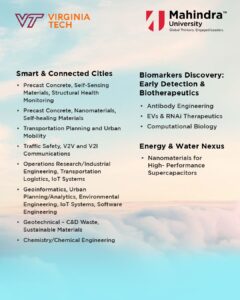
4) PhD: Waste Valorization → Smart Biopolymer Manufacturing (Mahindra University & Virginia Tech IARCT²) — Hyderabad, India
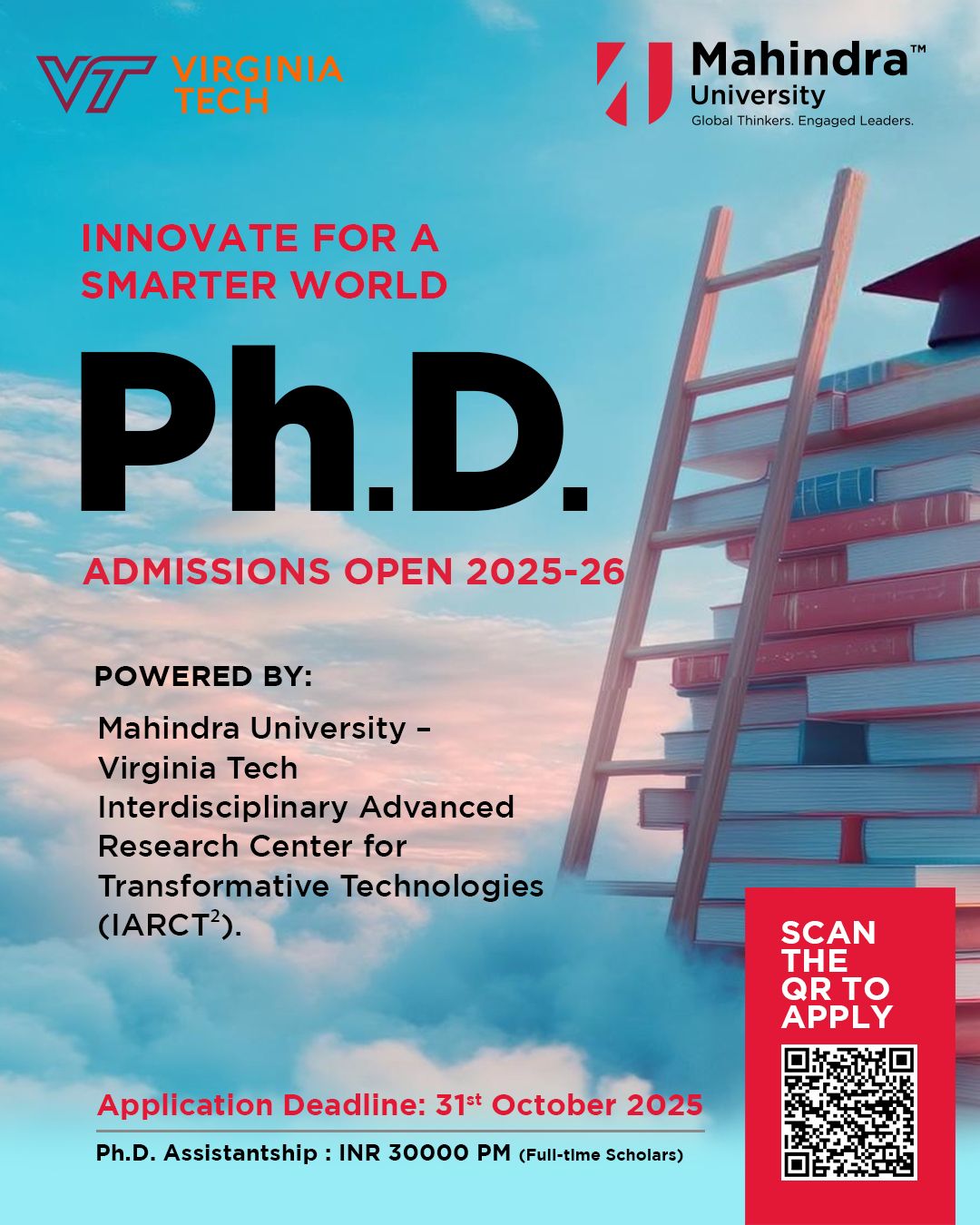
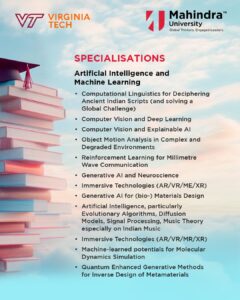
This interdisciplinary PhD project connects Mahindra University with Virginia Tech through the Interdisciplinary Advanced Research Center for Transformative Technologies (IARCT²). The theme is waste valorization toward manufacturing smart biopolymer materials, aligned with “Smart and Connected Cities – Smart Environment.”
Funding & support
- PhD Assistantship: INR 30,000 per month for selected full-time scholars.
- Application deadline: Apply by 15 November 2025 (QR/application details provided by the institute).
Research scope
- Converting agricultural or industrial waste streams into functional biopolymer feedstocks.
- Process optimization for scalable manufacturing of smart biopolymers (mechanical properties, biodegradability, functionalization).
- Integration with smart-city applications — sensors, biodegradable packaging, or structural components.
Candidate profile
- BTech/MTech/MSc in Materials Science, Chemical Engineering, Polymer Engineering, Environmental Engineering, or related fields.
- Background in polymer synthesis, characterization (DSC, TGA, FTIR), process scale-up, and materials testing.
- Interest in interdisciplinary collaboration and industrial translational research.
Application tips
- Emphasize prior work in polymer chemistry, waste processing, or materials characterization.
- Include experimental data or prior lab experience — sample preparation, mechanical testing, or pilot-scale trials.
- Articulate potential impact — how your work could reduce waste, create circular materials, or integrate with smart infrastructure.
- Outline collaboration intent with industry partners or potential translational pathways.
5) Pantouris Lab — University of the Pacific (USA) — Two PhD Positions
The Pantouris Lab (Department of Chemistry) is hiring two PhD candidates in Protein Chemistry/Cell Biology and Computational Chemistry (molecular dynamics simulations). These roles focus on understanding structure–function relationships in proteins relevant to cancer biology and immunomodulation. The lab emphasizes interdisciplinary research bridging experimental biochemistry and computational modeling.
Position 1 — Protein Chemistry / Cell Biology
Focus: Experimental characterization of novel immunomodulatory proteins — recombinant expression, purification, structural characterization, cell-based assays, and biochemical studies.
Key training & techniques:
- Recombinant protein expression and purification (E. coli, insect, or mammalian systems).
- Protein crystallography and structural studies.
- Mammalian cell culture and in vitro biochemical/biophysical assays.
- High-throughput screening workflows (small molecule screens).
Candidate requirements:
- Strong background in biochemistry, molecular biology, or related disciplines.
- Experience with protein expression, purification, or cell culture is a plus.
Position 2 — Computational Chemistry
Focus: Molecular dynamics (MD) simulations to probe biomolecular interactions — membrane or soluble protein systems, free energy calculations, and structural analysis.
Key training & tools:
- MD packages (GROMACS, AMBER, NAMD), force field expertise, and experience with enhanced-sampling techniques.
- Structural analysis tools, docking workflows, and post-processing pipelines.
- Integration with experimental data to inform hypotheses.
Candidate requirements:
- Strong computational background in MD simulations and structural biophysics.
Application instructions
- Prepare a single PDF including: (1) a short motivation letter (one short paragraph) and (2) a CV (max 2 pages), and email to Georgios Pantouris (gpantouris@pacific.edu).
- Minimum GPA requirement noted (e.g., 3.3) — follow the lab’s application instructions.
Why these positions matter
- Located near the Bay Area, the University of the Pacific offers proximity to a major biotech hub.
- Interdisciplinary training prepares students for academic research or industry roles in biotech and pharmaceutical development.
How to Craft an Effective Application (General Advice Across All Positions)
These positions vary in goals and location, but successful applications share common elements. Below is a practical, step-by-step approach to prepare and submit competitive applications.
1. Tailor documents to the role
- Cover letter / motivation statement should reference the specific project and list two or three concrete contributions you bring (skills, prior results, methods).
- CV: Highlight research experience, technical skills, publications, code repositories, and any patents or industry experience.
2. Present a concise research plan (where requested)
- For PhD and postdoc roles, include a 1–2 page research plan describing a problem, methodology, expected outcomes, and how your background enables success.
3. Provide strong references
- Choose referees who can directly speak to your research capability and potential for independent work. Provide them with your CV, application deadline, and a one-page summary of your achievements.
4. Demonstrate technical depth
- For soil and environmental roles: list lab instrumentation, analytical pipelines, and spatial modeling experience.
- For power electronics: provide prototype schematics, simulation results, and control algorithm descriptions.
- For computational roles: include GitHub links, notebooks, and short reproducible examples.
5. Meet administrative requirements
- For international positions, ensure you can provide certified transcripts or translations if requested.
- For positions with a residence permit requirement (e.g., Sweden), start visa-related paperwork early if you anticipate acceptance.
6. Proofread and format professionally
- Combine documents into a single PDF where requested. Use consistent fonts and section headings. Keep the CV concise (1–3 pages depending on experience).
Timeline and Prioritization — How to Manage Multiple Applications
When applying to several roles with overlapping deadlines, follow this prioritization strategy:
- Immediate deadlines (within 2–4 weeks): prioritize completions and submit first. For example, the European soil positions with November deadlines must be addressed urgently.
- Positions requiring pre-contact with PI: email supervisors early (2–4 weeks) and attach a brief tailored summary and CV.
- Interviews and follow-ups: prepare a concise research talk (10–15 minutes) and set aside time to rehearse lab-specific questions.
- Visa & documentation: for international posts (Sweden, Switzerland, Netherlands, USA), gather transcripts and certificate translations early.
Funding & Stipend Expectations
Funding varies by country and program:
- Europe (Sweden, Netherlands, Switzerland, Belgium): many doctoral positions are salaried (employee contracts) or fellowship-based; postdoc salaries are competitive but differ by institution. Expect to negotiate conference/travel budgets if not specified.
- India (Mahindra University, NIT Puducherry): assistantships and stipends are listed (e.g., INR 30,000/month for Mahindra University). Additional internal or governmental fellowships may be available.
- USA (University of the Pacific): PhD positions often include tuition waivers and stipends; details vary by department. Confirm with the lab for current stipend packages.
Practical Tips for Interviews and Selection Panels
- Prepare a 10–15 minute research presentation summarizing past work and a clear vision for your proposed PhD or postdoc work.
- Anticipate technical questions relevant to the advertised position—e.g., methods to quantify soil organic carbon, MPPT algorithms for power converters, or MD force-field selection.
- Ask thoughtful questions about lab structure, supervision style, collaboration networks, and expected milestones (publications, teaching duties, internship opportunities).
Career Outcomes and Next Steps After PhD/Postdoc
Each position is a launchpad toward academia, industry, or policy roles:
- Soil science & biogeochemistry → academic research, environmental consulting, policy, climate mitigation roles.
- Power electronics & energy systems → industry R&D for EVs, grid integration, renewable energy companies, startups.
- Waste valorization & biopolymers → materials industry, sustainable manufacturing, industrial collaboration.
- Protein chemistry & computational chemistry → biotech, pharmaceutical R&D, structural biology, computational drug design.
Closing Action Checklist
- For ETH Zürich, Ghent, and Wageningen soil science roles: prepare and submit applications before 11–14 November 2025 deadlines. Include tailored cover letters, CV, and referee details.
- For NIT Puducherry: read the PhD brochure, prepare the research statement and required documents, and contact the department for clarification if needed.
- For Aliah University: complete online application as per departmental instructions on the portal.
- For Mahindra University (IARCT²): apply via QR by 15 November 2025 and prepare to demonstrate interdisciplinary interest and materials/process knowledge.
- For Pantouris Lab: prepare a single PDF (one-paragraph motivation + 2-page CV) and email gpantouris@pacific.edu.